📰 The News
AI’s insatiable hunger for electricity is not a future problem; it is a *now* problem, actively bringing critical infrastructure to its knees. Forget the hype about new models; the real story is the silent battle raging in power grids across the globe. We are seeing data centers, the literal engines of the AI revolution, demanding unprecedented amounts of power, equivalent to entire cities, and our existing energy infrastructure simply cannot keep up.
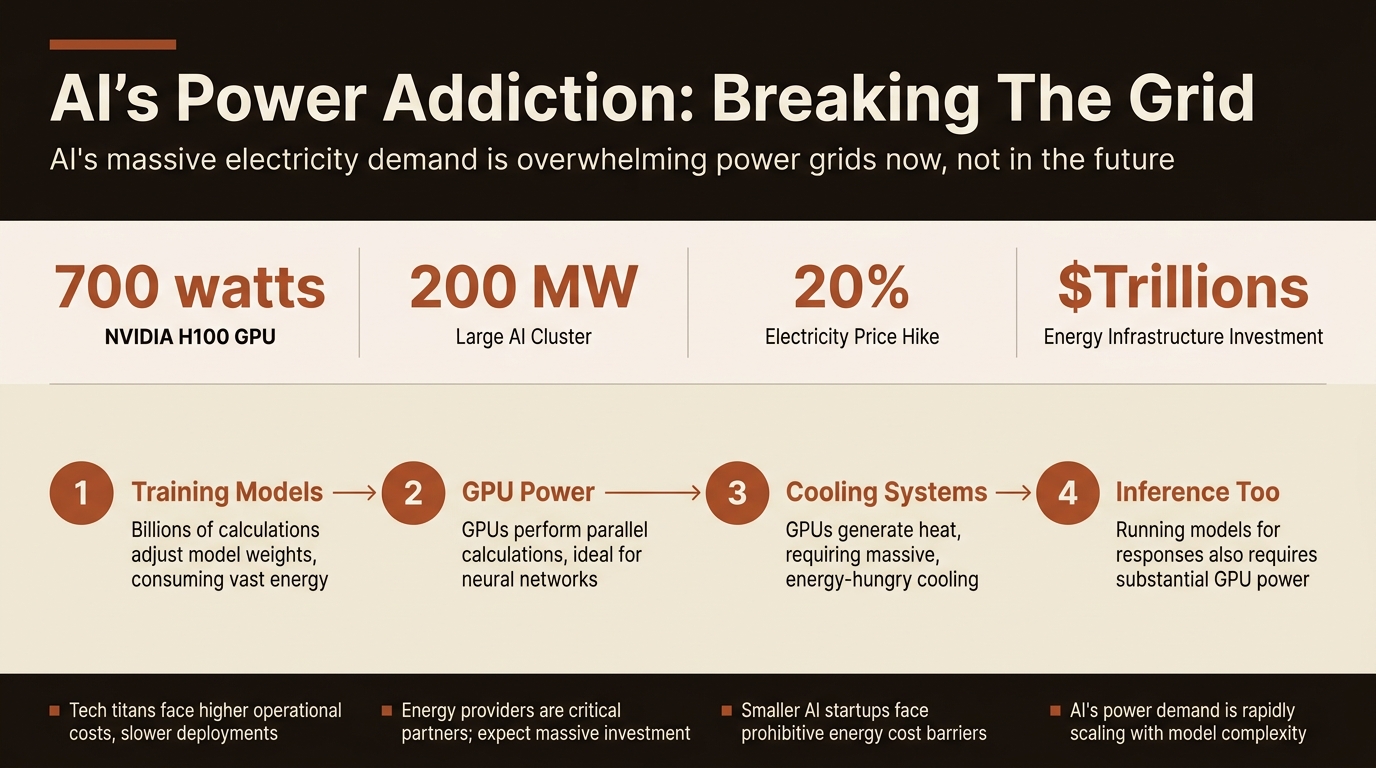
The numbers are staggering. Microsoft, Google, and Amazon Web Services are pouring billions into new AI-optimized data centers, each requiring hundreds of megawatts. NVIDIA’s H100 GPUs, the backbone of modern AI, consume up to 700 watts each. A single large AI cluster, comprising tens of thousands of these GPUs, can pull 100-200 MW, enough to power 100,000 to 200,000 homes. This demand is causing brownouts, delaying new data center construction, and forcing utilities to scramble for solutions.
Utilities like Dominion Energy in Virginia and Arizona Public Service are openly stating they cannot meet the projected demand without massive, rapid investment in new generation and transmission. This is not just an inconvenience. It is a fundamental bottleneck that threatens to slow the entire AI boom, impacting everything from autonomous vehicles to drug discovery. The next frontier for AI is not just better algorithms, it is securing enough electrons to run them.
💥 Why This Changes Everything
This energy crisis changes *everything* for the tech titans. Companies like OpenAI, Meta, and Google, who rely on massive compute for their models, face escalating operational costs and slower deployment cycles. A 20% increase in electricity prices, driven by this demand, could add hundreds of millions to their annual infrastructure budgets. This favors companies with deep pockets and existing energy deals, potentially consolidating power in the hands of a few. Smaller AI startups, already struggling for GPU access, will find the energy cost a prohibitive barrier to entry.
The impact extends far beyond Silicon Valley. Energy providers are suddenly the most critical partners in the AI race. Utilities that can rapidly scale renewable or nuclear generation, or those with robust grids, become strategic assets. Expect to see unprecedented investment in energy infrastructure, potentially trillions of dollars over the next decade. This creates massive opportunities for companies in nuclear power, advanced renewables, and grid modernization, but it also means higher electricity bills for every household and business.
For the everyday person, this means more than just a higher power bill. The promise of ubiquitous AI, powering everything from smart homes to personalized medicine, hinges on available energy. Delays in AI deployment could mean slower innovation in critical sectors, impacting job creation and economic growth. Furthermore, the environmental implications are severe: if this demand is met by fossil fuels, it will exacerbate climate change, directly affecting our health, our environment, and our future. This is a societal challenge, not just a tech problem.
🎓 Guru’s Education
Why does AI eat so much power? Think of it like this: training a large language model is like teaching a child the entire internet. It requires colossal amounts of mental effort, or in AI’s case, *computational* effort. Each time the model adjusts its internal “weights” based on new data, it is performing billions, even trillions, of calculations. This process, known as backpropagation, is extraordinarily energy-intensive, particularly for models with hundreds of billions or even trillions of parameters, like GPT-4 or Llama 3.
The core technology enabling this is the Graphics Processing Unit, or GPU. Unlike a CPU, which is good at general-purpose tasks, GPUs are designed to perform many simple calculations simultaneously, making them perfect for the matrix multiplications that underpin neural networks. Imagine thousands of tiny calculators working in parallel, all running at maximum capacity for weeks or months during a training run. Each of these calculators generates heat, requiring massive cooling systems, which themselves consume significant electricity.
Even after training, running these models for inference, meaning generating responses or predictions, requires substantial power. Every query you send to ChatGPT or every image generated by Midjourney triggers a cascade of calculations across these energy-hungry GPUs. This is why companies are investing heavily in specialized AI chips like Google’s TPUs or AWS’s Inferentia, which aim for greater energy efficiency. Understanding this fundamental computational cost is key to grasping the scale of the energy challenge; it is not simply inefficient code, it is the nature of deep learning itself.
🔮 The Guru’s Take
Here is what nobody is telling you: The current AI boom is entirely unsustainable on our existing energy infrastructure. We are on a collision course, and the companies that recognize this early will dominate the next decade. After 25 years building enterprise systems, I have seen every tech wave hit a wall. This time, the wall is made of electrons. The true winners will not just have the best models, but the most reliable and cost-effective access to power.
I am predicting a massive shift in corporate strategy. Expect to see tech giants acquiring energy companies, investing directly in power generation, and even building their own microgrids. Microsoft already has a deal with Constellation Energy for carbon-free power. Google is pouring billions into renewable energy projects. Companies that fail to secure their energy supply will face crippling operational costs and deployment delays, effectively being priced out of the AI race. This is not just about server racks; it is about power plants.
So, what should *you* do this week? If you are in tech, start asking about your company’s energy strategy. If you are an investor, look beyond model performance and scrutinize the energy footprint and power procurement deals of AI companies. This is the hidden variable that will determine winners and losers. The future of AI is not just intelligent algorithms; it is intelligent energy strategy. Bet on the companies that are building their own power plants, not just their own data centers.